
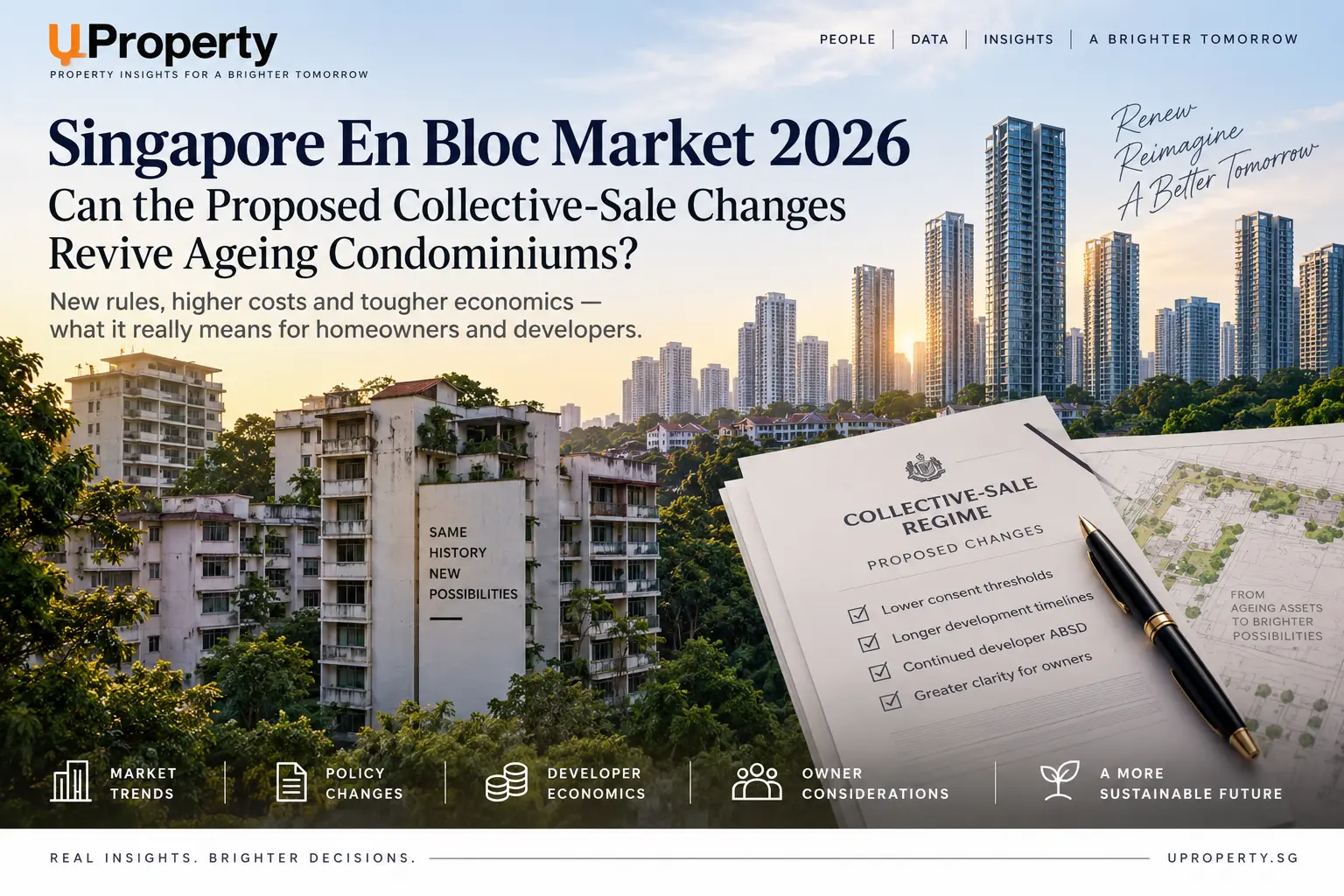
Singapore En Bloc Market 2026: Can Proposed Collective-Sale Changes Revive Ageing Condominiums?
Singapore is considering significant changes to its collective-sale framework for older developments. But lower consent thresholds alone cannot determine whether an en bloc sale succeeds. Land price, redevelopment potential, developer ABSD, financing, construction costs, planning constraints and owner expectations still have to align.
From the 2017–2018 boom to a much more selective market
Singapore’s collective-sale market looks very different from the last major en bloc cycle. Published market records cited by Business Times and CNA put the 2017 market at about 31 collective-sale deals worth S$8.5 billion, followed by approximately 36 deals worth S$10.3 billion in 2018.
It would, however, be too simplistic to say that developer ABSD alone caused the subsequent slowdown. Collective-sale appetite is affected by the interaction of land prices, construction and financing costs, expected selling prices, planning parameters, Land Betterment Charge where applicable, available Government Land Sales sites and the developer’s assessment of market risk.
Three large transactions show that en bloc sales can still happen
Several large transactions demonstrate that buyers will still commit substantial capital where the site characteristics, price and redevelopment case align.
| Development | Transaction | What the case illustrates |
|---|---|---|
| Chuan Park | S$890 million SPA dated 5 July 2022 | The Singapore High Court judgment records the S$890 million sale and the subsequent objections and collective-sale proceedings. |
| Thomson View Condominium | S$810 million Proposed acquisition in November 2024 | CapitaLand Development and UOL announced on 1 July 2025 that the High Court had granted the collective-sale order. |
| Loyang Valley | S$880 million April 2026 | The 362-unit development was reported sold on its third collective-sale attempt to a SingHaiyi-led consortium. |
These cases should not be read as proof that every ageing development possesses similar redevelopment potential. Site size, tenure, plot ratio, planning considerations, location, acquisition quantum and the number of new units a developer expects to create can produce very different economics from one estate to another.
What is the Government proposing to change?
The Ministry of Law says Singapore’s private developments have aged considerably since the majority-consent collective-sale framework was introduced in 1999. Older estates can require substantial investment in maintenance, repairs and upgrading to remain safe and liveable. The 2026 Bill therefore seeks to provide older developments with a more practical redevelopment option where there is broad owner support, while strengthening safeguards for owners who do not consent to a sale.
| Age of development | Current framework | 2026 Bill proposal |
|---|---|---|
| Less than 10 years | 90% | 90% |
| 10–39 years | 80% | 80% |
| 40–59 years | 80% | 70% PROPOSED |
| 60 years and older | 80% | 65% PROPOSED |
The percentages concern the statutory collective-sale consent requirements. Readers considering an actual collective sale should obtain professional legal advice on how the applicable share-value, strata-area and procedural requirements apply to their development.
Lower consent thresholds are only one part of the proposed reform
The proposed amendments are more balanced than the headline numbers might suggest. MinLaw is simultaneously proposing measures intended to reduce unsuccessful or prolonged collective-sale attempts and strengthen protection for non-consenting owners.
Among the proposals are a higher threshold for requisitioning the general meeting used to constitute a Collective Sale Committee, a reduction in the period for obtaining signatures to the Collective Sale Agreement from 12 months to six months, and an extension of the restriction period following a failed attempt from two years to three years.
What about ongoing collective-sale exercises?
MinLaw has also addressed transition arrangements. Most proposed amendments are intended to apply to ongoing exercises where the first signature to the Collective Sale Agreement has not been obtained as at the eventual commencement date.
Where the first CSA signature was already obtained before commencement, MinLaw says the existing framework will continue to apply. This is another reason owners should not assume that the proposed 70% or 65% thresholds can simply be applied to an exercise today.
The other side of the equation: developer ABSD
The collective-sale consent threshold determines whether owners can potentially progress a sale. It does not determine whether a developer will buy the land.
IRAS states that housing developers acquiring residential development sites are subject to an aggregate 40% ABSD framework: 35% may qualify for remission subject to the applicable conditions, while an additional 5% is non-remittable.
This creates a significant time-and-sales-risk consideration for developers. The economic issue is therefore not merely “How much land can we buy?” but also “Can we develop and sell the resulting project within the applicable conditions and timelines?”
July 2026: additional ABSD timeline flexibility for qualifying complex projects
This is separate from the August 2026 collective-sale Bill.
On 28 July 2026, the Government announced further extensions to Category 1 ABSD remission timelines for qualifying large-scale redevelopment projects. IRAS sets out specific eligibility criteria; the extensions should therefore not be interpreted as a blanket seven-year deadline for every en bloc redevelopment.
4 August 2026: MinLaw introduced proposed amendments to the statutory collective-sale regime, including the proposed 70% and 65% consent thresholds.
Why a lower consent threshold cannot guarantee an en bloc sale
Imagine that an older condominium reaches the required owner consent. A developer still has to decide how much the underlying site is economically worth.
− land acquisition cost
− construction and infrastructure costs
− financing costs
− applicable LBC / land-related charges
− taxes and developer ABSD exposure
− professional, marketing and other development costs
− contingency and required return
= economically supportable land value
This is intentionally simplified, but it illustrates why an owner’s expectation of land value may differ substantially from what a developer is prepared to bid.
The selling prices achieved by nearby new developments can be relevant evidence in assessing potential development revenue, but they do not translate directly into the collective-sale value of an older estate.
Land Betterment Charge is another variable
Where redevelopment results in a chargeable increase in land value arising from planning consent, Land Betterment Charge may form part of the redevelopment cost structure.
SLA reviews LBC rates twice yearly in consultation with the Chief Valuer. For the period beginning 1 September 2026, SLA reported that non-landed residential LBC rates increased by 3.4% on average. Of the 118 geographical sectors, 70 recorded increases of approximately 1% to 29%, while 48 were unchanged.
This should not be interpreted as LBC automatically increasing whenever a developer submits a high bid for a nearby Government Land Sales site. The applicable LBC depends on the statutory framework, site sector, use group, planning proposal and relevant land-value enhancement.
Does this mean another 2017–2018 en bloc boom is coming?
It is too early to make that conclusion.
The proposed framework could widen the number of older developments capable of achieving the statutory consent requirement. But eligibility to pursue a collective sale and commercial viability are two different questions.
Developers will still evaluate the total acquisition quantum, planning potential, expected saleable product, financing and construction environment, competing land supply, applicable taxes and charges, and the risk of carrying a large project through completion and sale.
For owners, the important question is therefore not simply: “Can we reach the required percentage?”
It is also: “At what price would redevelopment make economic sense to both owners and a prospective purchaser?”
For owners of ageing condominiums: en bloc is one possible pathway, not a retirement plan
Collective-sale discussions can become emotionally and financially significant, particularly where owners have lived in a development for decades. Some owners may welcome redevelopment; others may prefer to remain in their homes.
Neither position should be dismissed.
Owners should avoid assuming that age alone guarantees an eventual collective sale, that a lower statutory threshold guarantees a buyer, or that nearby new-launch prices determine their eventual sale proceeds.
A more prudent approach is to understand the estate’s tenure, planning parameters, maintenance position, redevelopment potential, realistic land economics and the legal collective-sale process before making major housing or financial decisions.
The numbers still have to work.
Primary references & further reading
- Ministry of Law — 4 August 2026. “Proposed Amendments to the Collective Sale Regime to Support Renewal of Ageing Developments and Strengthen Owner Safeguards.” MinLaw.
- IRAS — ABSD Housing Developers Remission. Current ABSD treatment and remission conditions for residential development sites. IRAS.
- IRAS — 2026 timeline extensions. ABSD Housing Developers Remission Timeline Extensions for Complex Projects and CORENET X. IRAS.
- Singapore Courts — [2023] SGHC 158. High Court judgment concerning the Chuan Park collective sale. Singapore Courts / eLitigation.
- CapitaLand Development — 1 July 2025. Announcement concerning the S$810 million collective acquisition of Thomson View Condominium and the High Court sale order. CapitaLand.
- Singapore Land Authority — 31 August 2026. Revision of Land Betterment Charge Rates from 1 September 2026. SLA.
- Council for Estate Agencies. Advertising Guidelines for Estate Agents and Salespersons. CEA.
Market-context references: Business Times historical collective-sale data for the 2017–2018 cycle; CNA reporting on the collective-sale framework; and EdgeProp’s April 2026 report on the S$880 million Loyang Valley transaction.