
Land Betterment Charge in Singapore: Why Redevelopment Costs Can Reach Billions
Land Betterment Charge can materially affect the economics of redevelopment, collective sales and major land transactions. Here is what LBC actually measures, why planning permission can create a charge, and why a prime Singapore site can potentially face an exceptionally large liability.
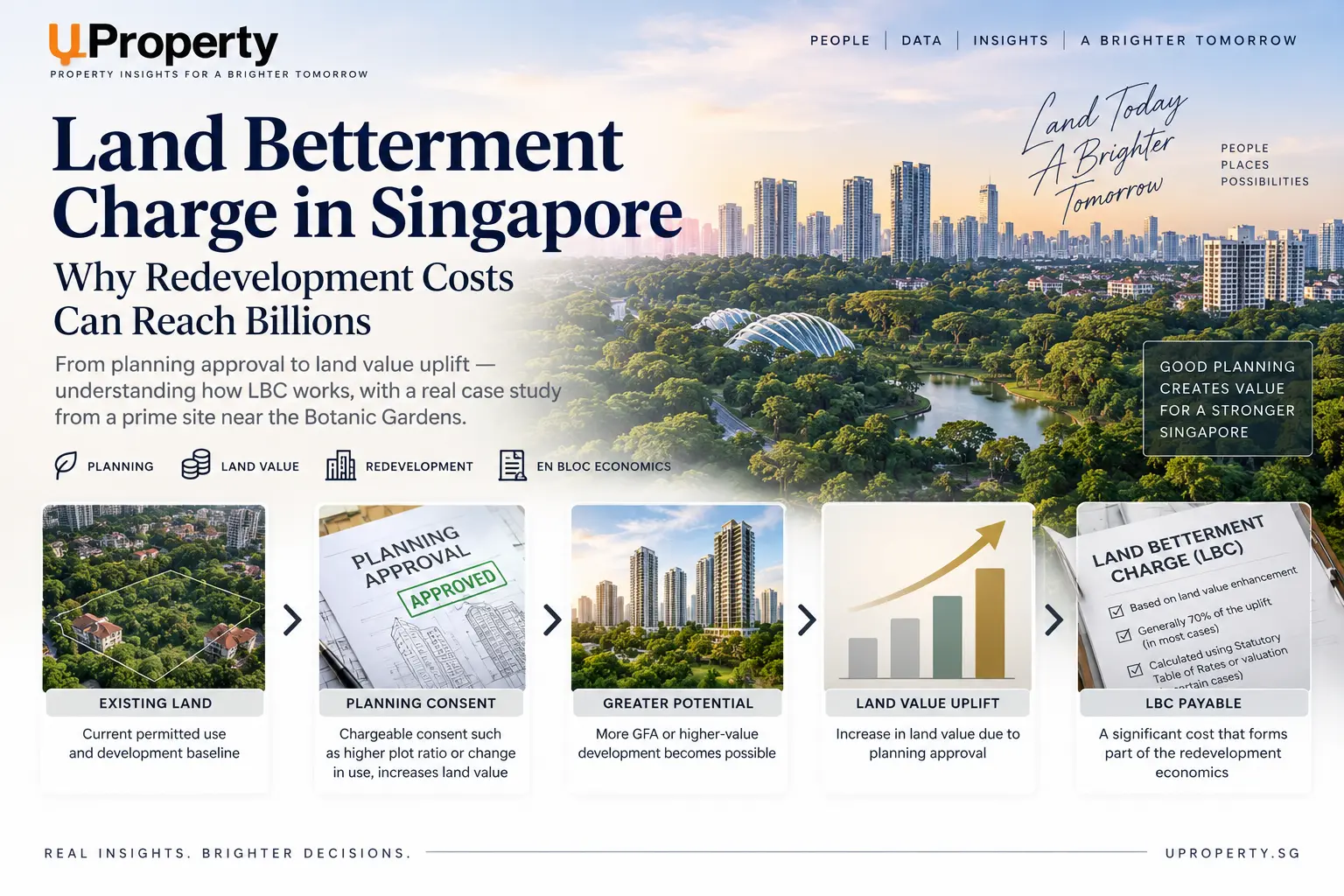
What is Land Betterment Charge?
The Land Betterment Charge regime came into force on 1 August 2022. It consolidated Singapore’s earlier development-charge, differential-premium and temporary-development-levy frameworks under the Singapore Land Authority.
SLA explains the principle in straightforward terms: where land is permitted to do more, for example, through a change to a higher-value use or an increase in development intensity, that planning decision may enhance its value.
LBC allows the community to capture part of that land-value enhancement.
A common misconception: LBC is not 70% of the property’s total value
This distinction is essential.
That is not an accurate general description of the Singapore LBC framework.
SLA states that, in most cases, LBC works out to approximately 70% of the enhancement in land value.
The important word is enhancement.
The charge relates to the increase in land value arising from the relevant planning permission or other chargeable consent not automatically 70% of the entire market value of the land.
− relevant pre-chargeable / baseline value
= enhancement in land value
LBC applies to the chargeable portion of that enhancement under the statutory framework.
This conceptual explanation is useful for understanding the policy, but it should not be used as a substitute for an actual LBC computation.
How is LBC actually calculated?
SLA says most LBC assessments use the Table of Rates method. The tables take into account two central variables: the geographical sector in which the land sits and the relevant use group.
The rates are reviewed twice each year in March and September in consultation with the Chief Valuer.
Table of Rates versus spot valuation
The published Table of Rates provides a relatively predictable basis for most cases. However, SLA also provides for spot valuation.
| Method | How it works | Important point |
|---|---|---|
| Table of Rates | Uses published rates based principally on the site’s geographical sector and applicable use group. | Used for most cases and gives owners and developers greater upfront predictability. |
| Spot valuation | A professional assessment by a designated valuer that can take site-specific attributes into account. | May apply where the tables are unsuitable, or can be elected in qualifying circumstances. SLA states that an election for spot valuation is irrevocable for that assessment. |
September 2026: non-landed residential LBC rates increased 3.4% on average
For the period from 1 September 2026 to 28 February 2027, SLA revised the LBC rates following its review in consultation with the Chief Valuer.
For Use Group B2 — Residential, Non-Landed, rates increased by 3.4% on average.
By comparison, SLA’s previous revision from 1 March 2026 had raised non-landed residential rates by 4.1% on average.
Why can the numbers become so large?
Three variables can combine to produce a very large potential LBC:
The 2026 Botanic Gardens-area land case
The landholding includes a plot involved in a 2025 land swap with the Singapore Government, which the report said would allow future development to be positioned farther away from the Singapore Botanic Gardens, a UNESCO World Heritage Site.
The report further said the prospective LBC had become an issue in discussions between the landowner and potential purchasers.
Why would a buyer care who legally pays the LBC?
Because the economics eventually feed back into the price the purchaser can afford to pay for the land.
Suppose a redevelopment has very high future sales potential. A developer still has to deduct the full cost of turning the land into the completed project.
− acquisition price
− LBC and applicable land-related charges
− construction and infrastructure costs
− financing costs
− professional and regulatory costs
− taxes and developer ABSD exposure
− marketing and selling costs
− contingency and required developer return
= development feasibility
Therefore, even if the contractual arrangement places the LBC payment responsibility on the purchaser, the purchaser will normally consider that cost when determining the maximum acquisition price it can economically support.
In property economics, this is one reason a major tax or land-related charge can become capitalised into the price of the site.
A simple illustration not a valuation
Consider a purely hypothetical redevelopment where planning permission creates an additional S$3 billion of land-value enhancement.
If, purely for illustration, the applicable charge represented approximately 70% of that enhancement, the result would be around S$2.1 billion.
Why this matters to en bloc owners
LBC is particularly relevant when owners of an ageing condominium look at nearby new-launch prices and try to infer what their entire site should be worth.
A common assumption might be:
Nearby selling prices can certainly be relevant to potential future revenue. But the developer does not simply multiply the future selling price by the site’s possible floor area and offer that amount to the owners.
The developer works backwards from potential revenue and deducts the entire cost and risk stack.
− construction
− financing
− LBC / applicable land charges
− developer ABSD exposure
− professional and infrastructure costs
− marketing and sales expenses
− risk and required return
= residual amount available to support the land acquisition
That is why the apparent value of a redevelopment can be very different from the price a developer is ultimately willing to offer existing owners.
Does every redevelopment trigger LBC?
No. The relevant question is whether there is a chargeable enhancement in land value under the LBC framework.
SLA’s explanation is particularly useful: if planning permission does not create the relevant enhancement, there may be no LBC arising from that change.
Conversely, a change of use, an increase in development intensity or the lifting of certain restrictions can potentially create an enhancement that falls within the regime.
Who actually pays?
SLA explains that the landowner is the default payee, but the statutory framework provides flexibility for another party to take responsibility following the prescribed notification process.
In a commercial transaction, buyer and seller may therefore negotiate who bears the payment obligation.
Economically, however, allocating the legal obligation does not make the cost disappear. A sophisticated buyer will normally incorporate it into the overall feasibility and acquisition price.
Why Singapore has an LBC system
LBC is not designed simply as an additional transaction tax.
SLA explains that development value can arise partly because of public planning decisions, transport infrastructure, utilities and the wider urban system surrounding the site.
The LBC regime therefore captures part of the uplift created through those planning decisions while leaving part of the enhancement with the landowner.
Planning may unlock additional development value, but that same planning uplift can create LBC. Developers then have to account for LBC alongside construction, financing, taxes, ABSD risk and their required return.
That is why understanding residual land value is essential when analysing a redevelopment or collective-sale opportunity.
What property owners should ask before relying on an LBC estimate
| Question | Why it matters |
|---|---|
| What is the site’s existing planning position? | LBC is concerned with enhancement relative to the relevant baseline, not merely the proposed end-state development. |
| What additional use or development intensity is being sought? | The nature of the planning uplift affects the potential enhancement. |
| Which geographical sector and use group apply? | These affect the applicable published Table of Rates. |
| Is the Table of Rates method appropriate? | Certain cases may involve or elect spot valuation. |
| Is the number official or merely indicative? | Media estimates, agent calculations and feasibility assumptions should not be described as a final statutory assessment. |
References & source hierarchy
- Singapore Land Authority — Land Betterment Charge. Official LBC framework, current tables, sector maps, use groups and published rates.
- Singapore Land Authority — “Demystifying the Land Betterment Charge”, 12 March 2026. Official explanation of land-value enhancement, Table of Rates, spot valuation, liability and the policy rationale for LBC.
- Singapore Land Authority — “Revision of Land Betterment Charge Rates from 1 September 2026”, 31 August 2026. Official September 2026 rate revision and data for Use Group B2 residential non-landed development.
- Singapore Land Authority — “Revision of Land Betterment Charge Rates from 1 March 2026”, 27 February 2026. Previous half-yearly rate revision used for comparison.
- The Business Times — 3 September 2026. Reporting on the 16.6-hectare Botanic Gardens-area landholding and analyst estimates that potential LBC could exceed S$2 billion. This is treated as a reported market estimate, not an official SLA assessment.