
Singapore En Bloc Rules 2026: Proposed Changes Explained for Condo Owners
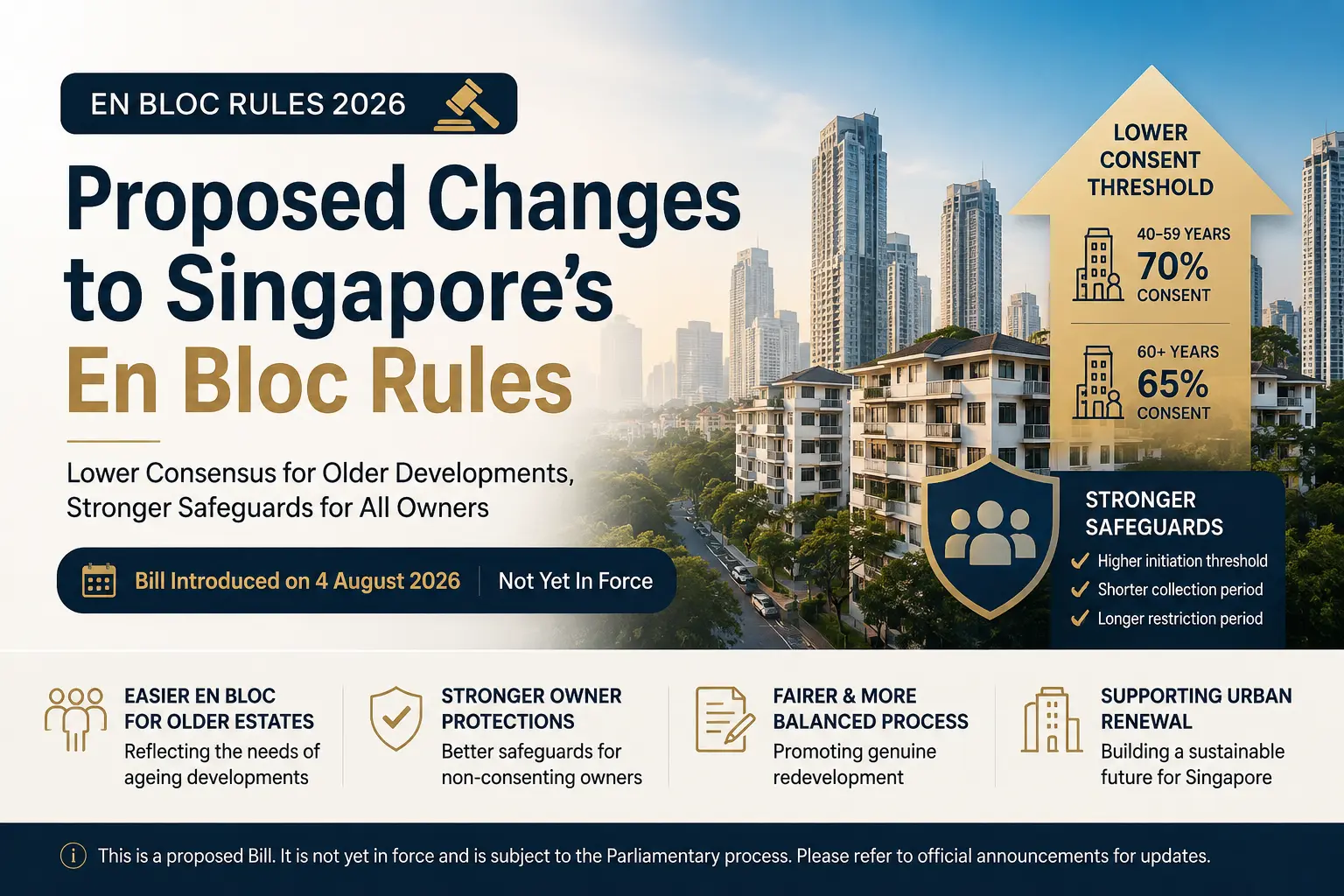
Singapore is proposing significant changes to its collective-sale framework for older private developments. The headline is a lower consent threshold for estates aged 40 years and above but the proposals also introduce stronger safeguards before, during and after an en bloc attempt.
The Land Titles (Strata) (Amendment) Bill 2026 was introduced for First Reading in Parliament on 4 August 2026. As at 13 August 2026, Parliament lists the Second Reading as “Next Available”. Until the relevant amendments are passed and brought into operation, the existing collective-sale framework continues to apply. [1] [2]
What Is Singapore Proposing to Change?
On 4 August 2026, Singapore’s Ministry of Law introduced the Land Titles (Strata) (Amendment) Bill 2026 for First Reading in Parliament. MinLaw said the proposed amendments are intended to better support the renewal of ageing developments and optimise land use, while strengthening safeguards for owners who do not support a collective sale. [1]
The proposal is particularly relevant to owners of older private condominiums and apartments because it would create new collective-sale consent thresholds for developments aged 40 years and above.
Proposed En Bloc Consent Thresholds
MinLaw proposes a more graduated collective-sale framework based on the age of the development. [1]
| Age of Development | Consent Threshold | Proposed Change |
|---|---|---|
| Less than 10 years | 90% | No change proposed |
| 10–39 years | 80% | No change proposed |
| 40–59 years | 70% | New proposed threshold |
| 60 years and older | 65% | New proposed threshold |
The existing thresholds of 90% for developments below 10 years old and 80% for developments aged 10–39 years would remain unchanged. [1]
Why is the age of a development becoming more important?
According to MinLaw, Singapore’s majority-consent collective-sale framework was introduced in 1999. Many developments have since become considerably older and may require substantial expenditure on maintenance, repair or upgrading in order to remain safe and liveable. [1]
The proposed lower thresholds therefore provide owners of older developments with another potential redevelopment option where there is already substantial support within the estate.
Important: a lower consent threshold does not mean every 40-year-old or 60-year-old condominium will become an en bloc candidate. Development age is only one part of a much broader legal, planning and commercial assessment.
Lower Thresholds But Stronger Safeguards for Owners
The proposed consent percentages have attracted attention, but the accompanying safeguards are equally significant.
Higher Threshold to Start an En Bloc Attempt
The proposal requires at least 35% of owners by share value or number of units to sign the requisition to convene a general meeting for the purpose of constituting a Collective Sale Committee.
MinLaw states that this is higher than the current thresholds of 20% by share value or 25% by number of units. [1]
Shorter Period to Obtain Signatures
Collective Sale Committees would have 6 months, instead of the current 12 months, to obtain the required signatures to the Collective Sale Agreement. [1]
Longer Restriction After an Unsuccessful Attempt
The restriction period following a failed collective-sale attempt would increase from 2 years to 3 years. During this period, heightened requisition thresholds would apply to another attempt to convene a meeting to form a Collective Sale Committee. [1]
Broader Framework for Certain Non-Strata Developments
The Bill also proposes extending the majority-consent collective-sale regime to certain non-strata-titled private residential developments where owners hold long leases in their units but do not own the underlying land, with safeguards for the landowner’s interest. [1]
UProperty interpretation: the proposed structure attempts to distinguish between an ageing estate with genuine broad support for renewal and repeated speculative attempts where owner support remains insufficient.
What Happens to En Bloc Exercises Already Underway?
Owners should not assume that an existing collective-sale exercise can immediately adopt the proposed 70% or 65% threshold.
MinLaw states that most of the proposed amendments would apply to ongoing collective-sale exercises where the first signature to the Collective Sale Agreement has not been obtained by the future commencement date. The commencement date has not yet been announced. [1]
Where the first signature to the Collective Sale Agreement has already been obtained before the commencement date, the existing framework would continue to apply. [1]
MinLaw also proposes transitional arrangements allowing certain Collective Sale Committees that are still gathering signatures to decide whether to terminate the existing agreement and approve a new agreement under the revised framework. Such committees would be given 7 months from commencement to achieve the applicable threshold for the new agreement. [1]
Why this matters: the eventual commencement provisions and transitional rules may materially affect an estate already considering or undertaking a collective-sale exercise. Owners should obtain appropriate professional and legal advice for development-specific circumstances.
A Separate but Related Change: Developer ABSD Rules
A second policy development occurred shortly before the proposed collective-sale amendments and should be understood separately.
On 28 July 2026, the Ministry of Finance and Ministry of National Development announced revisions to the Additional Buyer’s Stamp Duty for Housing Developers [ABSD(HD)] remission framework for large-scale en bloc redevelopment sites. [3]
Unlike the proposed collective-sale amendments, these ABSD revisions already apply to qualifying residential land acquired on or after 29 July 2026. [3] [4]
| Site Category | Redevelopment Yield | Minimum Intensification | Completion & Sale Timeline | Intermediate Sales Condition |
|---|---|---|---|---|
| Regular En Bloc Site | 5–699 units | — | 5 years | None |
| Large Site — Category 1A | 700–1,399 units | 1.5× | 6 years | None |
| Mega Site — Category 1B | 1,400 units or more | 1.5× | 7 years | At least 50% sold by end of Year 6 |
For both Large and Mega Sites, the commencement timeline remains 2.5 years. To qualify for the extended completion and sale timelines, the number of residential units after redevelopment must also be at least 1.5 times the number of units in the existing development. [3]
For Mega Sites, developers must sell at least 50% of residential units by the end of Year 6. Failure to meet this condition can result in the full clawback of the 35% upfront remittable ABSD component with interest. [3]
How do the two policy developments connect?
Both measures can be viewed in the wider context of urban renewal and housing supply, but they operate at different stages and should not be presented as if one automatically causes the other.
Channel NewsAsia also reported on the 28 July developer ABSD revisions, explaining the longer timelines for qualifying Large and Mega en bloc projects. [4]
What Could the Proposed Rules Mean for Owners of Older Condominiums?
The headline percentage should not be the starting point for an owner’s decision. A more useful assessment looks at the development itself and the owner’s wider housing circumstances.
1. Age of the development
Under the proposal, a 35-year-old, 45-year-old and 65-year-old development would fall into different consent-threshold categories.
2. Remaining lease and tenure
Development age and land tenure are related considerations but are not the same. An ageing freehold estate and an ageing leasehold development may present materially different redevelopment economics.
3. Planning and redevelopment potential
Land area alone does not determine whether a development is attractive for redevelopment. Relevant considerations may include applicable planning controls, allowable development intensity, access, infrastructure and other site-specific requirements.
4. Commercial viability
Owners may naturally consider the proceeds they would require to replace their homes. A developer, however, must evaluate the acquisition against redevelopment cost, financing, construction, expected selling prices, competing supply, development risk and the overall viability of the project.
5. The alternative to a collective sale
Owners may also wish to consider matters such as:
- future maintenance and repair requirements;
- sinking-fund adequacy;
- major upgrading expenditure;
- remaining lease where relevant;
- recent resale activity and liquidity;
- the condition and competitiveness of the development; and
- their own housing, retirement and financial plans.
An en bloc discussion is therefore better approached as a property-planning and redevelopment question, rather than as an assumption of an automatic windfall.
Does This Mean an En Bloc Boom Is Coming?
Not necessarily.
Even if the proposed consent thresholds eventually become law, securing the applicable level of owner consent removes only one hurdle.
A collective sale still requires commercially viable redevelopment economics.
- the reserve and acquisition price;
- redevelopment potential;
- applicable planning requirements;
- construction and financing costs;
- potential lease-related or land-related costs where applicable;
- expected future selling prices;
- buyer demand;
- competing residential supply; and
- execution and market risk.
What These 2026 Changes Do and Do Not Mean
UProperty Perspective: Urban Renewal With Balance
The significance of the proposed amendments goes beyond the headline reduction in consent percentages.
The structure appears designed to address two objectives simultaneously:
- give owners of genuinely ageing developments a more practical redevelopment option where substantial support already exists; and
- strengthen safeguards against prolonged or repeated collective-sale exercises where support is insufficient.
Singapore has limited land and an ageing stock of private residential buildings. At the same time, a residential development is not merely a parcel of land — it is also home to individual owners with different financial, family, retirement and housing circumstances.
A sustainable collective-sale framework therefore has to balance urban renewal, efficient land use, property rights, commercial feasibility and protection for non-consenting owners.
MinLaw expressly states that the Bill seeks both to support the renewal of ageing developments and strengthen safeguards for non-consenting owners. [1]
Frequently Asked Questions About Singapore En Bloc Rules 2026
Are Singapore’s proposed new en bloc thresholds already in effect?
What is the proposed en bloc threshold for a 40-year-old condominium?
A development aged 40–59 years would fall under the proposed 70% consent threshold. [1]
What is the proposed threshold for developments aged 60 years or older?
The proposed consent threshold for developments aged 60 years or more is 65%. [1]
Will the en bloc threshold change for newer condominiums?
Under the Bill, the existing thresholds would remain unchanged at 90% for developments below 10 years and 80% for developments aged 10–39 years. [1]
Does achieving the required owner consent guarantee an en bloc sale?
No. Owner consent is only one component of the collective-sale process. The site must still attract a commercially acceptable purchaser and satisfy the applicable legal, regulatory and transaction requirements.
Are the July 2026 developer ABSD changes the same as the proposed en bloc law?
No. They are separate measures. The revised developer ABSD framework applies to qualifying large-scale en bloc redevelopment land acquired from 29 July 2026, while the collective-sale amendments introduced on 4 August 2026 remain proposed legislation as at the date of this article. [3]
Does the proposed change mean my older condo is suitable for en bloc?
Not necessarily. Development age is only one consideration. Owners should also consider tenure, planning context, recent transactions, redevelopment potential, market conditions, likely developer appetite and their own housing objectives.
Own a Property in an Older Development?
Before asking whether your estate “will go en bloc”, start with the fundamentals: development age, tenure, recent transactions, planning context, current resale position and your own housing objectives.
Official Sources & References
Primary government sources are used wherever possible. CNA is credited as secondary news reporting and is not presented as the source of the legislation.
- Ministry of Law, Singapore — “Proposed Amendments to the Collective Sale Regime to Support Renewal of Ageing Developments and Strengthen Owner Safeguards”, 4 August 2026. Primary source
View Ministry of Law announcement - Parliament of Singapore — Land Titles (Strata) (Amendment) Bill, Bill No. 18/2026, introduced 4 August 2026. Primary source
View Bills Introduced - Ministry of Finance / Ministry of National Development — “Revisions to Additional Buyer’s Stamp Duty Regime to Support Housing Developers Undertaking Large-scale En Bloc Redevelopments”, 28 July 2026. Primary source
View MOF/MND announcement - Channel NewsAsia — “Housing developers of large en bloc projects to get more time to sell units under revised ABSD rules”, 28 July 2026. News reporting
Read CNA report - Council for Estate Agencies — guidance and disciplinary case study concerning inaccurate and misleading property advertisements. Compliance reference
View CEA compliance reference
This article is provided for general educational and property-market information purposes and reflects information available as at 13 August 2026. The Land Titles (Strata) (Amendment) Bill 2026 discussed above is proposed legislation and is not yet in force as at the stated review date.
Legislation, regulations, tax treatment, planning requirements and market conditions may change. Collective-sale circumstances differ between developments. Nothing on this page constitutes legal, tax, financial, investment, valuation or redevelopment advice, nor does it constitute a prediction, representation or guarantee that any particular property or development will undergo or successfully complete a collective sale.
Readers should independently verify material information with the relevant Singapore Government agencies and obtain appropriate legal, financial, tax, valuation or property advice where required before making a material decision.
Property information and commentary should be factual and capable of verification. CEA’s Code of Ethics and Professional Client Care requires estate agents and salespersons not to cause or allow advertisements containing inaccurate, false or misleading information. [5]