
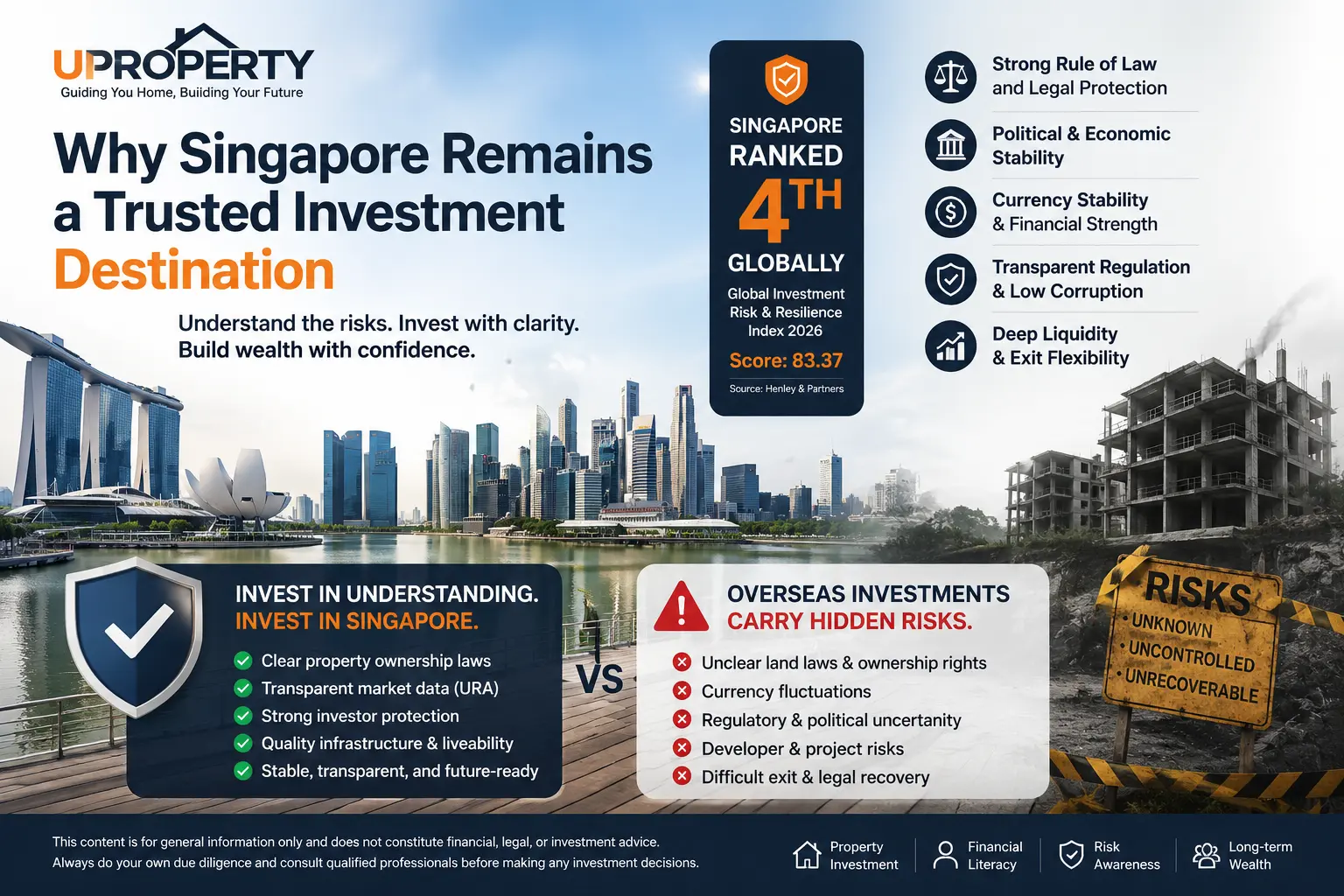
Why Singapore Remains a Trusted Investment Destination And Why Overseas Property Requires Extra Due Diligence
Singapore continues to attract global investors not only because of property but also because of the system behind it: legal certainty, transparent regulation, political stability, financial discipline, market data, and enforceable ownership rights.
A recent global risk-resilience ranking placed Singapore among the top countries for investment resilience. The Henley & Partners Global Investment Risk and Resilience Index May 2026 update ranked Singapore 4th globally, with a score of 83.37. This does not mean every Singapore investment will make money. It means Singapore is viewed strongly from a system-level perspective, including resilience, governance, legal certainty and risk exposure.
This distinction is important. A safe country does not remove investment risk. It simply gives investors a clearer framework for evaluating risk, ownership, financing, tax, regulation, and exit options.
What Is Investment?
Investment means putting money into an asset or product with the expectation of future benefit, such as income, capital growth, wealth preservation or portfolio diversification. However, all investments carry risk. MoneySense, Singapore’s national financial education programme, reminds investors that investing may generate better returns than ordinary savings, but investors can also lose some or all of their invested money.
Common Types of Investments
Before comparing Singapore property with overseas opportunities, it is useful to understand that property is only one type of investment. Investors usually build wealth through a mix of asset classes, depending on their objectives, risk tolerance, time horizon and liquidity needs.
| Investment Type | Simple Meaning | Key Risk to Understand |
|---|---|---|
| Property | Buying real estate for own stay, rental income, capital preservation or long-term capital growth. | Market cycle, interest rates, vacancy, maintenance, taxes, financing and exit liquidity. |
| Shares | Buying ownership in a listed company. | Business performance, market volatility and valuation risk. |
| Bonds and Treasury Bills | Lending money to a government or company in return for interest. | Credit risk, interest-rate risk and reinvestment risk. |
| Unit Trusts and Funds | Pooling money with other investors under professional management. | Manager performance, fees, market exposure and product complexity. |
| ETFs | Exchange-traded funds that track a market, sector or strategy. | Market risk, tracking difference and liquidity risk. |
| REITs | Listed trusts that own income-producing real estate. | Interest rates, tenant risk, gearing, asset quality and distribution sustainability. |
| Business or Private Investments | Investing directly into a business, project or private opportunity. | High due-diligence burden, low liquidity, governance risk and possible capital loss. |
Why Singapore Remains Attractive to Global Investors
Singapore’s appeal is not built only on property price performance. It is built on institutional trust. Investors value a jurisdiction where the rules are clearer, the data is more accessible, contracts are enforceable, and regulatory expectations are more transparent.
1. Rule of Law and Legal Certainty
Investors need confidence that ownership rights, contractual obligations and dispute resolution are supported by a reliable legal framework. MAS highlights Singapore’s strong rule of law and economic stability as key strengths of its wealth management hub.
2. Transparent and Efficient Regulation
Singapore is recognised for its transparent and efficient regulatory framework. EDB describes Singapore as a trusted business ecosystem supported by strong government support, transparent regulations and competitive tax policies.
3. Reliable Market Data
In Singapore, property buyers can refer to official public information such as URA’s private residential time-series statistics, which are updated quarterly. This helps investors study market movements with official data instead of relying only on sales claims.
4. Political and Economic Stability
For long-term investors, stability matters. A stable environment reduces uncertainty in financing, taxation, regulation, ownership and exit planning. This is one reason Singapore continues to be viewed as a trusted hub for capital, business and wealth management.
Why Some Investors Lose Money Overseas
Overseas property can offer real opportunities. Some investors may seek lower entry prices, higher projected yields, lifestyle diversification or exposure to another country’s growth story. But overseas investing also carries additional layers of risk that may not be obvious during a sales presentation.
Common Overseas Property Risks
- Country risk: political change, economic instability, foreign ownership restrictions or policy shifts.
- Legal risk: different land laws, unclear title, weak buyer protection or difficulty enforcing contracts.
- Currency risk: exchange-rate movement can reduce returns even when the property performs as projected.
- Developer risk: project delay, non-completion, quality issues or weak financial standing.
- Rental risk: projected yield may not match actual tenant demand, vacancy period or management cost.
- Exit risk: the investor may find it difficult to sell, repatriate funds or recover capital.
- Information risk: investors may rely heavily on marketing material without independent verification.
A recent Singapore news report is a serious reminder. CNA reported that 347 investors lost a total of S$16 million after an Australia housing scheme promoted through a Singapore property agent’s company fell through. This case should not be read as proof that all overseas investments are bad. Instead, it highlights why investors must understand the promoter, structure, legal documents, asset, jurisdiction and downside risk before committing money.
Singapore Property Is Not Risk-Free Either
A balanced view is important. Singapore property is not a guaranteed investment. Prices can move, rental demand can change, interest rates can affect affordability, government cooling measures can influence demand, and the wrong purchase price can limit future returns.
The difference is that Singapore provides a clearer and more transparent framework for investors to conduct due diligence. Buyers can examine URA data, transaction history, project details, lease tenure, financing rules, stamp duties, rental evidence and comparable market information before making a decision.
How to Evaluate Any Property Investment
Whether the property is in Singapore or overseas, investors should not start with the promised return. They should start with the risk framework.
| Due-Diligence Question | Why It Matters |
|---|---|
| Who owns the asset and what exactly am I buying? | Clarifies title, ownership structure, land rights and investor protection. |
| Is the developer, seller or promoter properly verified? | Reduces the risk of dealing with parties that lack track record, licence or financial strength. |
| Are the rental assumptions independently supported? | Prevents over-reliance on projected yields that may not reflect actual demand. |
| What happens if the project is delayed or not completed? | Tests the downside scenario before capital is committed. |
| Can I exit the investment realistically? | Liquidity matters. A paper gain is not useful if there is no buyer or no clear exit process. |
| What are the taxes, fees and foreign exchange risks? | Net return can be very different from advertised gross return. |
| Have I received independent legal, tax and financial advice? | Property investment often involves legal, tax and financing issues beyond sales advice. |
What This Means for Singapore Buyers
The key lesson is not to avoid all overseas opportunities. The key lesson is to understand what you are investing in. A good investment is not only about the highest projected return. It should be understandable, legal, financeable, sustainable and recoverable if something goes wrong.
For Singapore property, the advantage is not that every purchase will be profitable. The advantage is that the investor has more access to official information, clearer regulation, stronger consumer protection and a more familiar legal environment.
Final Thoughts
Singapore remains a trusted investment destination because many investors value clarity, stability and enforceability. These qualities may not always produce the highest short-term returns, but they can reduce avoidable uncertainty.
Overseas property may still have a place in some investors’ portfolios, but it requires a higher standard of due diligence. Before comparing prices and projected yields, investors should first compare legal protection, currency risk, developer reliability, market transparency and the ability to exit.
In property investment, the safest decision is rarely the most exciting one. It is usually the one where the investor understands both the upside and the downside before signing.
Thinking About a Singapore Property Decision?
UProperty focuses on practical, data-aware and compliance-conscious property education for buyers, sellers, landlords, tenants and long-term property planners in Singapore.
This article is for general educational information only. It does not constitute financial advice, legal advice, tax advice, investment advice, valuation advice, or a recommendation to buy, sell, rent or invest in any specific property, project, country or financial product. Past performance, projected yield, ranking or market resilience should not be treated as a guarantee of future returns. Readers should perform their own due diligence and consult qualified financial, legal, tax and property professionals before making any decision.
UProperty is a property education and content platform and is not an estate agency. Estate agency work in Singapore must be conducted through a licensed estate agent and registered salesperson where applicable. Written by Andrew Koh, licensed real estate salesperson with OrangeTee & Tie Pte Ltd. CEA Reg No:R018334F. Readers may verify salesperson registration through the CEA Public Register.
References
- Henley & Partners — Global Investment Risk and Resilience Index, May 2026 Update: View source
- MoneySense — What Is Investing: View source
- MoneySense — An Introduction to Types of Investments: View source
- Singapore Economic Development Board — Singapore’s Business-Friendly Environment: View source
- Monetary Authority of Singapore — Wealth Management: View source
- URA — Private Residential Time Series Statistics: View source
- Council for Estate Agencies — What to Take Note of When Engaging a Property Agent: View source
- CNA — Property Agent Promoted Australia Housing Scheme That Lost Investors S$16 Million: View source